Budapest through an analog lens feels different. This 3.5-hour English-language photo trip strings together classic monuments and calmer viewpoints, while you learn to shoot with analog cameras. You also move like a local, using the city’s transport as part of the flow, not as a chore.
I love the way the guide keeps the vibe easy and practical, especially when you’re new to analog. Emese Tárnok’s communication and patient teaching style make it much less intimidating. I also love the payoff: you come away with physical photos you can actually hold as a souvenir.
One thing to consider: the stops are short (think about 5–15 minutes each), so this isn’t the tour for you if you want long, slow time inside buildings or for deep museum-style wandering.
In This Review
- Analog Photo Trip at a Glance: What Makes It Worth Your Evening
- A 5:00 pm Photo Walk With Analog Cameras in Budapest
- Price and Value: Is $142.97 Reasonable for What You Get?
- Starting Point at CBI CompareBudapest: Getting Oriented Fast
- How the Route Moves: Short Stops, Big Views, and Practical Photo Time
- Stop 1: St. Stephen’s Basilica (Szent Istvan Bazilika) in 15 Minutes
- Stop 2: Széchenyi Lánchíd and the Chain Bridge Photo Setup
- Stop 3: Hungarian Parliament Building at Kossuth Lajos Square
- Stop 4: Margaret Bridge for a View Back (and Forward)
- Stop 5: Matthias Church for Gothic Details in Only 5 Minutes
- Stop 6: Fisherman’s Bastion for Early Medieval-Style Inspiration
- What Emese Tárnok’s Leadership Adds to the Experience
- Who This Tour Is For (and Who Might Prefer Something Else)
- Should You Book Analog Photo Trip?
- FAQ
- What time does the tour start?
- How long is the experience?
- Where does the tour begin and where does it end?
- Is the tour offered in English?
- How many people are in the group?
- Do I need to buy admission tickets for the stops?
- What if the weather is bad or I need to cancel?
Analog Photo Trip at a Glance: What Makes It Worth Your Evening
- Analog cameras with hands-on basics so you’re not guessing settings the whole time
- A tight, scenic route that layers major landmarks with quick framing opportunities
- Free-admission time at each listed stop, keeping the focus on seeing and shooting
- Small group size (max 12), which helps with questions and slower pacing
- Guided pacing that still gives room to look rather than just marching past sights
- Emese Tárnok as the lead guide, known for smooth pre-trip and on-trip communication
A 5:00 pm Photo Walk With Analog Cameras in Budapest
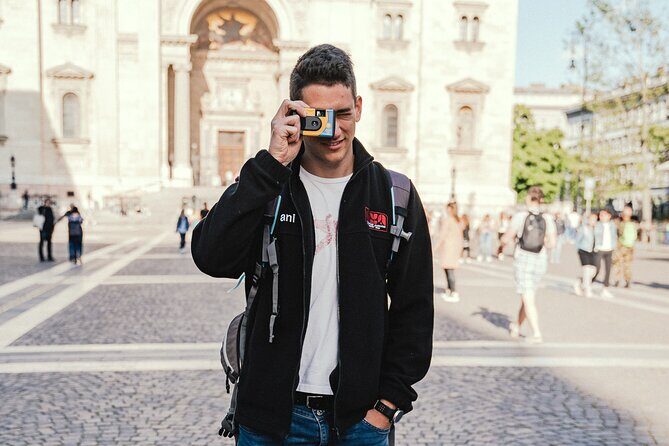
The tour starts at 5:00 pm, which is a smart time to see Budapest. Daylight still lingers long enough for photos, but the light starts to soften, and the city feels more human than mid-afternoon crowds. You’ll be out long enough to learn and shoot, but not so long that you feel trapped in one spot.
What makes this experience special is the built-in excuse to slow down. Instead of just sightseeing, you’re actively looking for frames. That small shift changes how you notice details: angles, silhouettes, the way buildings relate to the river, and how the skyline compresses from different viewpoints.
You’ll also get a mobile ticket, so you’re not wasting time with paper vouchers. And because the route stays close to public transportation, you can usually orient yourself quickly if you arrive a bit early or need to adjust your pace.
You can also read our reviews of more tours and experiences in Budapest.

Price and Value: Is $142.97 Reasonable for What You Get?
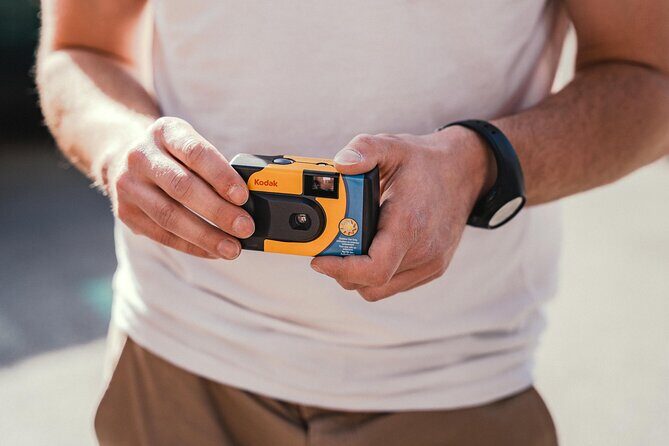
At $142.97 per person for about 3 hours 30 minutes, this isn’t the cheapest way to do Budapest highlights. But it does value you in a few clear ways.
First, you’re paying for guided time that’s built around photography. The guide gives you brief instruction on the analog cameras, and the group structure (max 12) makes it easier to get help without feeling rushed. That’s not just “stand here and take a picture” guidance—it’s a learning moment.
Second, the souvenir is real. You don’t just end with digital images. You take home physical photos, which many people find more satisfying because they’re tangible and tied to that exact evening in Budapest.
Third, many sightseeing breaks listed are free admission, so you’re not stacking ticket costs on top of the tour price. The trade-off is that you’re not spending hours at any one museum stop. You’re sampling, framing, and moving.
If you want a guided evening that also teaches a new skill and gives you a concrete keepsake, the price makes sense. If you mainly want a relaxed, long sit-down sightseeing loop, you might feel like the time moves quickly.
Starting Point at CBI CompareBudapest: Getting Oriented Fast
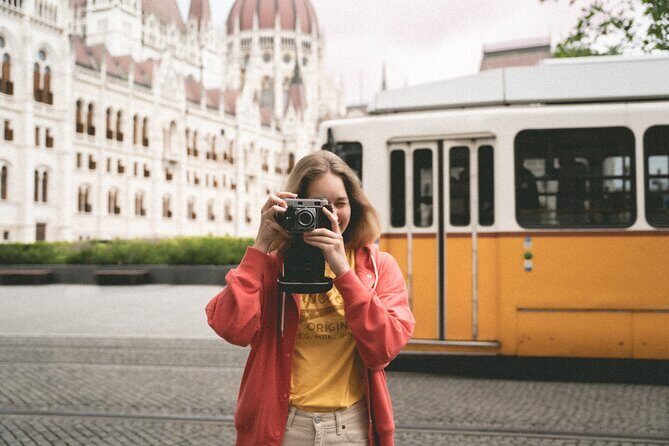
Your tour meets at CBI CompareBudapest, Anker köz 2-4, 1061 Hungary. It’s an easy-to-aim address in central Budapest, and the tour is described as being near public transportation, which matters because Budapest days can run late when you’re hopping between districts.
Since the tour begins at 5:00 pm, I recommend arriving early enough to settle your bearings. You’ll want a calm moment before the analog camera intro, and it’s easier to focus when you’re not sprinting to the meeting point.
The tour ends at Fisherman’s Bastion, Budapest, 1014 Hungary. That endpoint is handy because it’s already one of the places you’ll likely want to return to later for more photos, even if you don’t have a plan after the tour.
How the Route Moves: Short Stops, Big Views, and Practical Photo Time
This trip is built around quick landmark pauses. Each stop has a defined window, which keeps the route from turning into a slow shuffle. The total time is long enough to learn and shoot, but the camera stops are tight enough to keep momentum.
In practice, that means you’ll get:
- a brief explanation and context at each major point
- time to frame photos using your analog camera
- movement to the next scenic view without feeling lost
The best part of this style is that you’ll see more of Budapest’s “big-name” landmarks without being stuck in line after line. The trade-off is the pace. If you’re the type who wants to linger for 45 minutes in one church or take 200 photos from one angle, you may wish you had more freedom. Still, even with the schedule, the guide’s pacing is built to let you stop and look rather than just rushing through.
Stop 1: St. Stephen’s Basilica (Szent Istvan Bazilika) in 15 Minutes
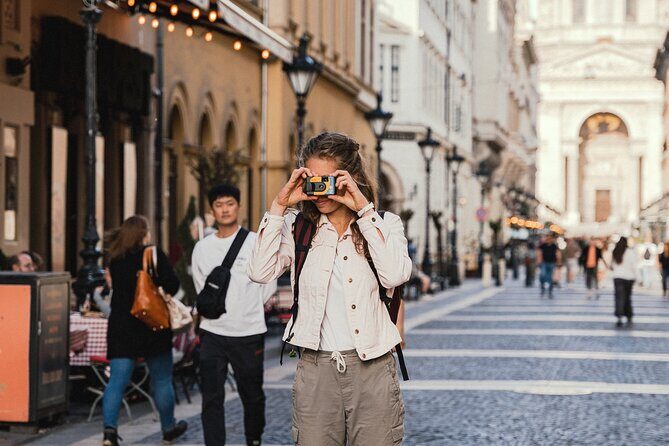
Your first major stop is St. Stephen’s Basilica, and the focus here is simple: look around and get the story behind Hungary’s most important church. It’s listed as 15 minutes with admission ticket free.
What I like about opening at this point is how it sets the cultural tone right away. Before you shoot river bridges and government buildings, you start with a place that anchors the country’s identity. Even if you’re not a religious architecture person, the basilica’s role in Hungary’s story gives your photos a layer of meaning.
A practical tip for this kind of stop: treat it like a photo warm-up. Take a few test shots early so you’re familiar with the camera rhythm before you hit the broader river views later.
Potential drawback: with only 15 minutes, you won’t get a full “slow tour” inside. If you want a long interior visit, plan to return after the trip.

Stop 2: Széchenyi Lánchíd and the Chain Bridge Photo Setup
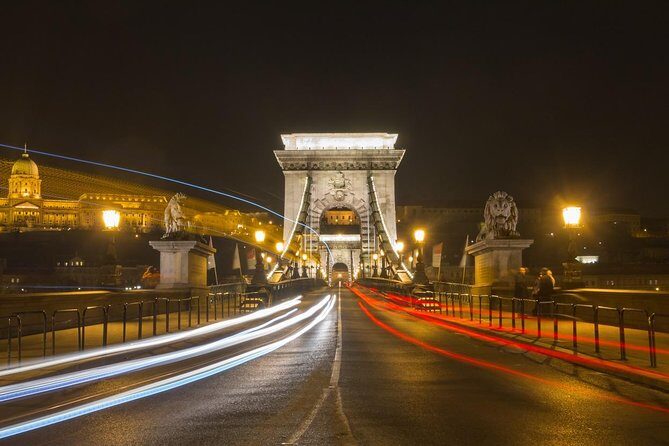
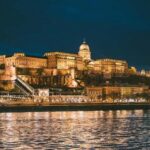
Next you head to Széchenyi Lánchíd, the famous Chain Bridge. You’ll capture the view of the bridge with Buda Castle in the background. This stop is also 15 minutes, and it’s described as admission ticket free.
There’s a lot going on visually here: strong bridge lines, river reflections when conditions cooperate, and a skyline that frames itself differently depending on where you stand. This is one of those locations where having a guide helps because you know where to aim your attention, not just where the landmark is.
The tour also mentions Tram 2 in this segment. You’ll be guided on when to take it as you move onward, which is helpful because it keeps the route logical instead of turning into guessing how to get from one view to the next.
Photo approach tip: think in layers. If your camera allows it, try one shot emphasizing the bridge’s structure, and another one that includes the Castle silhouette. Different compositions tell different parts of the story.
Stop 3: Hungarian Parliament Building at Kossuth Lajos Square
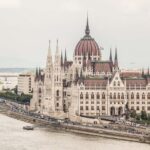
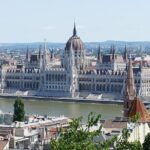
Then you step into the wide open feel of Kossuth Lajos square, with the Hungarian Parliament Building nearby. This segment is 15 minutes with admission ticket free noted.
The value here is context. You’re not just looking at a big building; you’re learning about the history of the place and the surrounding area. That matters for your photos because it changes how you frame the scene. You start to see how the architecture connects to political identity and how the square functions as a public stage.
One consideration: you’ll likely be photographing outdoors from public space. That’s good for analog because you’ll have plenty of natural light, but it also means you’re at the mercy of street conditions—people moving through your frame, shifting angles, and weather.
Stop 4: Margaret Bridge for a View Back (and Forward)
At Margaret Bridge, you get an “in-between” perspective. From here, you’ll have a view of the places you came from and the places you have ahead during the analog photo trip. This is 15 minutes, and admission ticket free.
I like this stop because it turns the tour into a story you can photograph. You’re not just shooting one highlight at a time. You’re capturing the route like a sequence—your past angles, your next angles, and the river connecting everything.
Margaret Bridge also helps you reset your eyes. After the intensity of major landmarks, it’s a chance to step back and look at the whole city as a connected system. That’s especially useful when you’re learning analog photography, because you’ll want to manage pacing and not burn all your best frames too early.
Stop 5: Matthias Church for Gothic Details in Only 5 Minutes
Your next photo stop is Matthias Church. This one is brief: 5 minutes, admission ticket free noted. The goal is to capture the church’s Gothic beauty.
Short stops can feel risky on a photo tour, but here it works because the church has strong visual identity. Even in a few minutes, you can get a handful of angles that show the character of the building.
My practical advice: don’t treat Matthias Church like a slow sightseeing pause. Treat it like a “grab the signature details” stop. Think edges, stone texture, and distinctive shapes—things analog cameras can record beautifully.
Stop 6: Fisherman’s Bastion for Early Medieval-Style Inspiration
Finally, you arrive at Fisherman’s Bastion, with 15 minutes on site and admission ticket free noted. This area is inspired by the architectural style of early medieval times, and that influence shows in the look and feel of the viewpoints.
This is a strong ending point because it’s photogenic from multiple angles. The spot also gives your analog set a satisfying closing image: the kind of panorama that makes people understand why Budapest gets repeated in postcards.
Also, since the tour ends here, you can keep exploring afterward if you still want more angles. And because you already learned how the route works, you’ll find it easier to decide where to go next.
What Emese Tárnok’s Leadership Adds to the Experience
A lot of photo tours fail when the guide assumes everyone already knows what to do. This one avoids that. Emese Tárnok’s role matters because she brings both city knowledge and clear instruction. People say communication before, during, and after is smooth, and that the guide is kind and patient if you’re slower than the group pace.
That’s a big deal when you’re working with analog gear, because you don’t want stress on top of a schedule. A small group (max 12) also supports this. You’re less likely to feel like your questions get ignored, and it’s easier to take the time you need to frame.
You’ll get a brief intro to the analog cameras, and the guide helps you learn how to use them without making it complicated. That’s the difference between a “nice walk with photos” and a tour where you actually learn something new.
Who This Tour Is For (and Who Might Prefer Something Else)
This Analog Photo Trip fits best if you:
- want a guided way to hit major sights in a single evening
- like the idea of learning a hands-on skill, not just taking pictures
- care about souvenirs and want physical photos
- enjoy city history told in a practical street-level way
It’s also ideal if you’re traveling with someone you want to share an experience with. The small-group format and the guided camera learning make it feel social but not chaotic.
You might want to choose another option if you:
- hate time limits at stops (some segments are only 5 minutes)
- want long indoor visits or museum-style pacing
- need a completely flexible route with lots of free wandering time
Should You Book Analog Photo Trip?
Yes, I think you should book this tour if you want a Budapest evening that mixes landmark viewing with a real creative challenge. The combination of analog camera instruction, a route that hits famous viewpoints plus quieter perspective spots, and the chance to take home physical photos makes it feel more personal than a standard highlights walk.
Book it especially if you’re okay with short stops. You’re trading deep time in any one location for the satisfaction of seeing many key places and learning enough to produce photos you’ll remember.
If your goal is only to stand and look at big monuments for a long time, you might feel limited. But if you want something active, guided, and genuinely different, this is a strong choice.
FAQ
What time does the tour start?
The Analog Photo Trip starts at 5:00 pm.
How long is the experience?
It lasts about 3 hours 30 minutes (approx.).
Where does the tour begin and where does it end?
You meet at CBI CompareBudapest, Anker köz 2-4, 1061 Hungary and the tour ends at Fisherman’s Bastion, Budapest, 1014 Hungary.
Is the tour offered in English?
Yes, it’s offered in English.
How many people are in the group?
The tour has a maximum of 12 travelers.
Do I need to buy admission tickets for the stops?
The stops listed in the itinerary indicate admission ticket free for each segment.
What if the weather is bad or I need to cancel?
The experience requires good weather. If it’s canceled due to poor weather, you’ll be offered a different date or a full refund. You also have free cancellation up to 24 hours in advance for a full refund.