REVIEW · BUDAPEST
Communist Budapest Walking Tour
Book on GetYourGuide →Operated by insightcities.com · Bookable on GetYourGuide
Communism in Budapest isn’t just an idea. It’s built into squares, apartments, statues, and even bus routes—and this tour walks you through how that system shaped daily life and politics. You’ll see the stuff people argued about, protested about, and suffered through, from 1956 to the long cold decades afterward.
I especially like two things about this experience. First, the guiding approach is conversational and guided by historical context, not just a list of landmarks. Second, the route connects major political events to everyday spaces, like the 1970s housing estates where families got elevators and modern conveniences. That practical link is what makes the story stick.
The main drawback to consider is that this is an overview tour. If you already know a lot about Hungary from WWII through 1989, you may want more time on the deeper “how it worked day to day” details, not just the big set pieces.
In This Review
- Key takeaways before you go
- A Budapest Tour That Explains Power Through Places
- Starting at Bambi Eszpresszó on Frankel Leó út: Set the Tone Fast
- Bem József Square to Kossuth Square: From 1956 Momentum to Parliamentary Memory
- Freedom Square and the Cold War Clock: Reagan, the U.S. Embassy, Soviet Forces, and an Atomic Shelter
- 1970s Housing Estates at the City Edge: The Day-to-Day Side of Control
- Puskas Stadium: Social Realist Statues and the Art of Political Persuasion
- Stalin’s Trolley Bus to Dozsa György Street: May Day on a Broad Boulevard
- House of Terror and the Berlin Wall Slab: The Cost of the System
- Price and logistics: Is $123 worth 3 hours?
- Who should book, and who might want a different tour?
- Should you book the Communist Budapest Walking Tour?
- FAQ
- How long is the Communist Budapest Walking Tour?
- Where does the tour start?
- What’s included in the price?
- Do I need tram and metro tickets?
- What language is the tour in?
- What stops will I see on the route?
- Is the tour private or small group?
- What kind of guides run the tour?
- Is cancellation free?
Key takeaways before you go
- Historian-led storytelling: You’re guided by academics and writers such as professors, doctoral students, historians, journalists, and art critics.
- 1956 Revolution trail: You move from major uprising sites around Parliament to monuments tied to armed conflict and political change.
- Cold War visuals: Freedom Square’s cluster of U.S., Soviet, and Reagan-era symbolism is literal, not abstract.
- Daily-life proof: The walk includes 1970s housing estates at the city edge, showing how life improved in small ways even under control.
- Social Realist art in the real world: You’ll see how heroic workers and soldiers were used to sell a political future.
- A blunt finish: The House of Terror memorializes communist crimes, with a Berlin Wall slab outside for a hard reality check.
A Budapest Tour That Explains Power Through Places
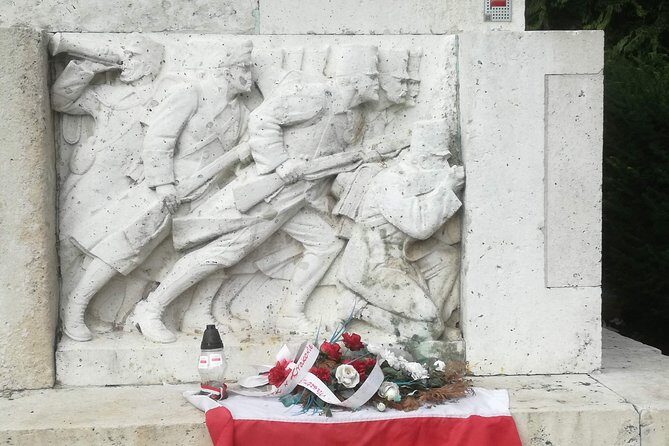
Budapest has a talent for turning politics into architecture. This tour leans into that. You won’t just stand and read plaques; you’ll connect the dots between what the state demanded and what people were allowed to keep—small freedoms in exchange for obedience on bigger issues.
The tour’s framing is built around the idea of Communist Budapest under totalitarianism, but with the specific Hungarian flavor often called goulash communism. In plain terms: it wasn’t one uniform experience for everyone every day. Some years felt tighter, other years felt softer, and your guide helps you understand how the “rules” were enforced.
If you enjoy history that feels concrete, you’re in the right place. You start in a square where the 1956 uprising really took off, then you slide into the language of the era—metro rides, parade boulevards, housing blocks, and the kind of public art that aimed to produce belief.
You can also read our reviews of more walking tours in Budapest
Starting at Bambi Eszpresszó on Frankel Leó út: Set the Tone Fast
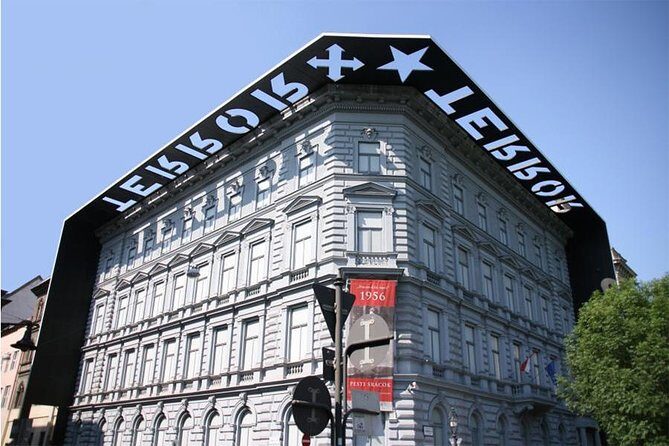
You meet at Bambi Eszpresszó, Frankel Leó út 2/4 (1027). That matters because the tour begins with a city habit, not a museum. Coffee first, history second—very Budapest.
From there, you head toward Bem József Square, where one of the first large demonstrations connected to the 1956 uprising took place. This is a strong opener because it anchors everything else you’ll see later. When you understand that the revolution wasn’t just a headline, you start noticing the physical evidence of political pressure everywhere.
One of the smarter details here is a coffee stop that keeps its original 1960s interior. Even if you never take a seat, the idea is clear: life under communism wasn’t only about ideology. It was also about spaces people used every day, with their own routines and moods.
Practical note: you’re in English, and guides are often historians and researchers. You’ll get explanations that feel like they were built for real people, not for a classroom quiz.
Bem József Square to Kossuth Square: From 1956 Momentum to Parliamentary Memory
After Bem József Square, you take the metro toward Kossuth Square, tied to some of the era’s most important public moments. The shift from one square to another isn’t random. It mirrors how 1956 moved between protest energy and the state’s formal power.
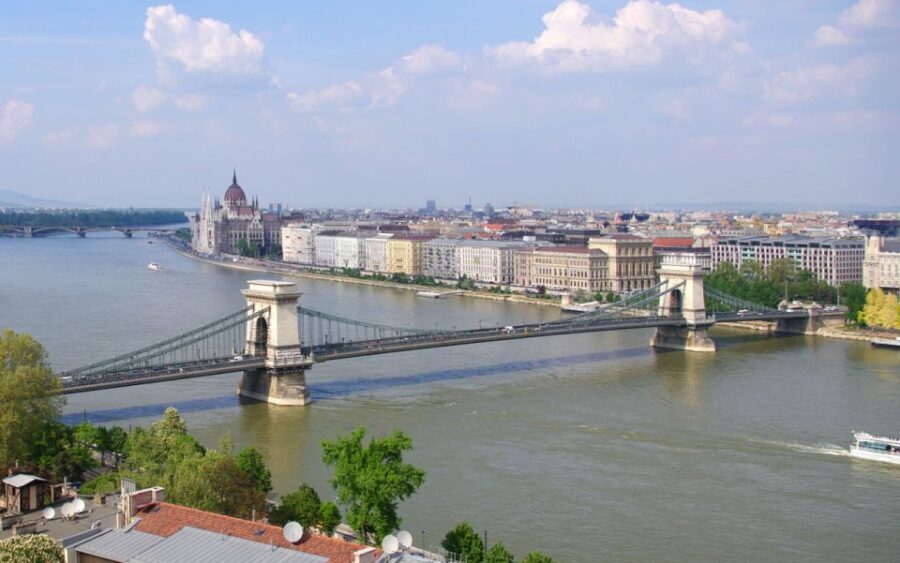
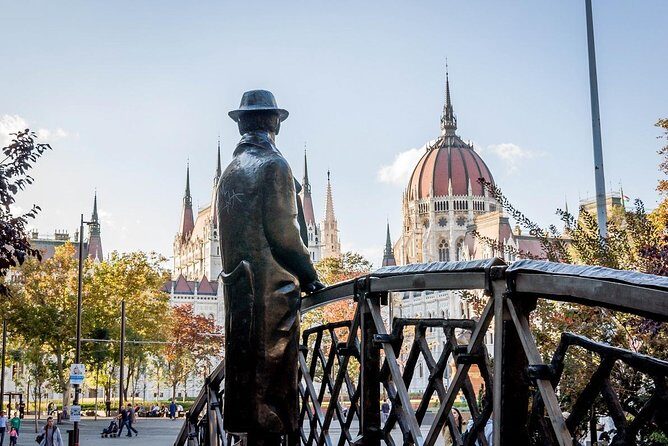
Kossuth Square is where Parliament sits, and in front of it you’ll see monuments associated with the political and armed conflicts of the revolution. These markers help you understand how a movement becomes history on the ground. You’re not just looking at “what happened,” you’re seeing how the city chose to remember it.
This section works best when you treat monuments as arguments. Ask yourself: who is being honored? Who is being blamed? What does the placement suggest about public memory? Your guide’s job is to give you the context to read the city correctly, including what those conflicts meant for everyday people trying to live normal lives while politics got violent.
The pace here is important. This is a 3-hour tour, and it moves at a relaxed walking tempo—ideal if you want to absorb without feeling sprinted.
Freedom Square and the Cold War Clock: Reagan, the U.S. Embassy, Soviet Forces, and an Atomic Shelter
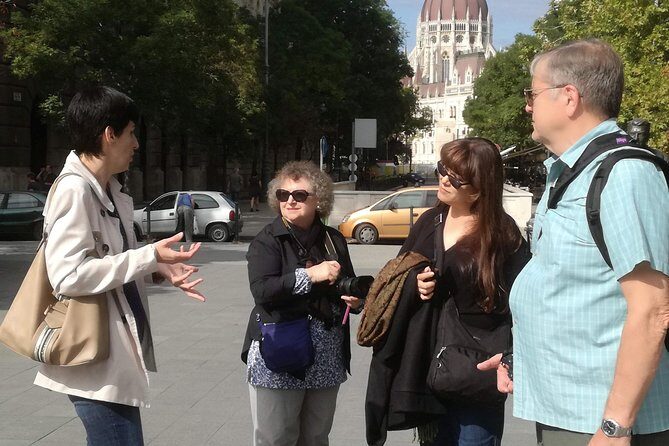
Then comes one of the tour’s most visually memorable segments: Freedom Square (Szabadság tér). The site is famous for turning Cold War tensions into a set of symbols you can see with your own eyes.
You’ll encounter four stone structures that represent the Cold War from multiple angles:
- the U.S. embassy
- a monument to the Soviet army
- a statue of President Ronald Reagan
- and the entrance to a secret atomic shelter
That last detail changes how the whole tour feels. It’s one thing to talk about ideology. It’s another to know there was literally a place designed for survival if things went nuclear.
This is where the guide’s historical lens becomes very practical. You’ll start noticing that Budapest didn’t just experience world politics from a distance. It hosted the symbols, the reminders, and the consequences. Freedom Square becomes a snapshot of the era’s logic: power meant security, but security also meant fear.
1970s Housing Estates at the City Edge: The Day-to-Day Side of Control
Next you ride the metro to 1970s housing estates on the edge of the city center. From a distance, the blocks can look drab and grey today. But you’re meant to see the contrast.
At the time, many young Hungarian families were genuinely excited to get an apartment there. The big selling points weren’t slogans. They were physical improvements: elevators and modern conveniences that were not common in older Budapest buildings.
I like how this stop reframes communism. It wasn’t only repression. It was also the state managing resources and housing. That created real improvements for some families—even while political freedom stayed limited and surveillance stayed in the background.
You’ll also get a better sense of how “progress” worked under the system. People might experience upgrades in comfort, while the state controlled the bigger levers: speech, movement, organization, and political risk. Your guide helps you hold both ideas at once, instead of reducing the period to one emotional snapshot.



Puskas Stadium: Social Realist Statues and the Art of Political Persuasion
The tour then takes you to the former People’s Stadium, now Puskás Aréna (the home of Puskás Soccer Stadium). Even if you’ve seen sports venues before, this stop is different because it focuses on Social Realist statues.
This style of art was built to persuade. You’ll see figures of heroic workers, soldiers, and intellectuals pointing toward a bright future. In other words, the message wasn’t subtle. Public art was propaganda you walked past on your way to everyday life.
Why this works on a walking tour: you can connect the art to the city’s physical flow. This isn’t a gallery where the works sit safely behind glass. The statements were meant to shape belief in public space—every day, not just during speeches.
If you like noticing visual cues, focus on posture and expression. Social Realism usually pushes optimism and purpose through the body language of its figures. Your guide ties those details back to the political logic behind the art.
Stalin’s Trolley Bus to Dozsa György Street: May Day on a Broad Boulevard
One of the more fun parts is transport: you take a short ride on a Stalin-era trolley bus to Dozsa György Street, a broad boulevard used for May Day parades.
Even if you don’t care about buses, this stop gives you something rare in history tours: movement. A parade route isn’t just a place—it’s stagecraft. It’s the kind of space meant to show power at scale, with crowds in view and messages visible from far away.
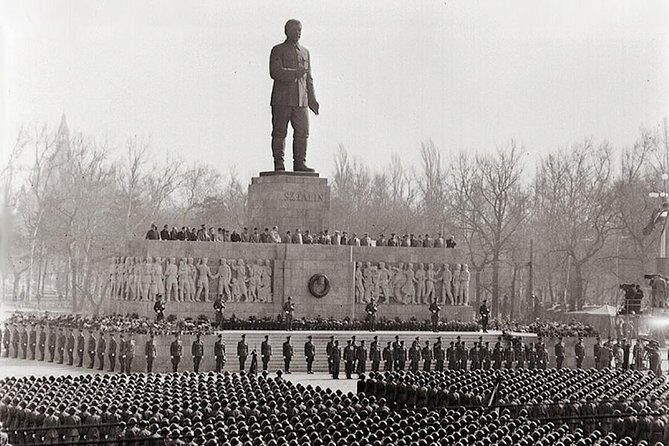
Your guide uses an iPad with old photos to show the difference between how the avenue looks now versus during Stalin’s era. That “then and now” method helps you see what changed and what didn’t. In a city like Budapest, layers overlap. You walk today, but you’re also tracing older intentions.
This also helps you understand propaganda as design. If a government wants to look legitimate, it needs a city that makes its rituals look impressive.
House of Terror and the Berlin Wall Slab: The Cost of the System
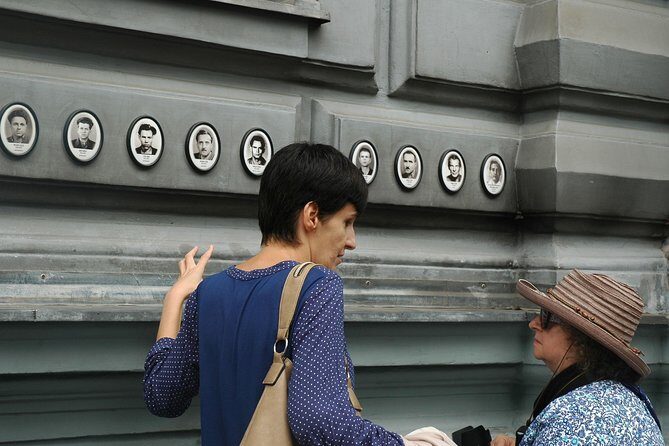
The tour finishes with a hard turn: the House of Terror, a museum in the former headquarters of the secret services. It commemorates the crimes of communism, especially during the Stalinist years.
This stop isn’t meant to be “comfortable history.” The point is to show what the machinery of the system did to real people. When you’ve spent hours walking through symbols of power—squares, monuments, housing programs—this museum forces the moral accounting.
Outside, you’ll also see a slab of the Berlin Wall. That detail matters because it ties Budapest’s experience to the broader European story of control and fear. It’s another physical reminder that the era’s divisions weren’t theoretical.
If you’re the type who likes closure, keep your expectations realistic. This isn’t a neat ending. It’s a reality-based final chapter.
Price and logistics: Is $123 worth 3 hours?
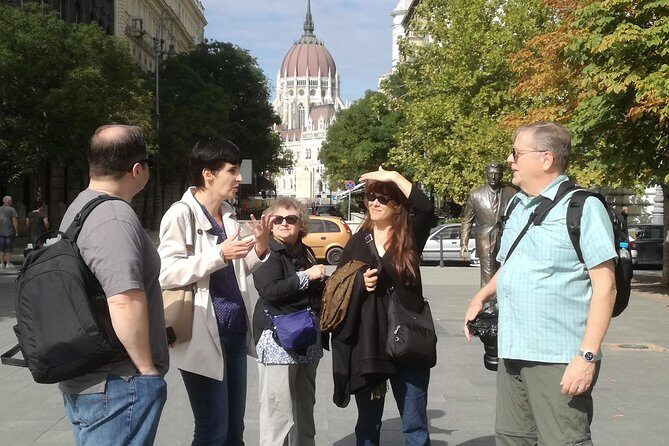
At $123 per person for a 3-hour tour, this sits in the mid-to-higher range for walking tours. The value comes from two things listed right up front:
- a historian guide
- and a route that uses multiple transport modes to cover distinct time periods and themes
Also, you’re not paying only for “seeing places.” You’re paying for interpretation. And the guide pool includes professors, doctoral students, historians, journalists, art critics, and published authors. That makes a difference when the tour is connecting architecture to political control and repression.
One important practical catch: tram and metro tickets aren’t included. You’ll use public transport during the tour, so plan to have tickets ready. Comfortable shoes also matter. Even though the pace is described as relaxed, you are covering a lot of ground in a short window.
Think of this as a concentrated education session in the city. If you want a quick, well-structured orientation to communist Budapest from 1956 through later decades, the pricing is easier to justify.
Who should book, and who might want a different tour?
This tour is a strong fit if you:
- are new to Hungarian history between the end of WWII and 1989
- want a clear thread from 1956 events to later decades
- like “places you can point at” when you study politics
- appreciate guides who adjust based on what you already know
It’s also a good match for people who want a gentler pacing style. One guide named András is singled out for conversation and an easygoing rhythm, and that kind of delivery helps a lot when the topics are heavy.
If you already have solid background knowledge and you’re looking for a deeper focus on the mechanics of everyday life under communism, you might find yourself wanting more. The tour is designed as an overview that ties major landmarks together. It may not satisfy someone searching for highly specific detail you’d expect from a specialist lecture.
In short: this is ideal for getting your bearings fast, and for understanding what each site meant and why it mattered.
Should you book the Communist Budapest Walking Tour?
Yes, if you want a smart, human-paced introduction to communist-era Budapest through the city’s most telling physical clues. You’ll leave with a better map in your head: 1956 protest energy, Cold War symbolism, real housing upgrades under the system, propaganda art at a major stadium, and the blunt memorial weight of the House of Terror.
I’d skip it only if you already know the period extremely well and you want a more advanced, highly detailed focus on daily life mechanisms or on the transition beyond what this route can cover in 3 hours.
FAQ
How long is the Communist Budapest Walking Tour?
It lasts 3 hours.
Where does the tour start?
The meeting point is Bambi Eszpresszó, Frankel Leó út 2/4, 1027 Budapest, Hungary.
What’s included in the price?
The tour includes a 3-hour walking tour and a historian guide.
Do I need tram and metro tickets?
Yes. Tram and metro tickets are not included, even though the tour uses the metro during the route.
What language is the tour in?
The tour is offered in English.
What stops will I see on the route?
You’ll visit Bem József Square, Kossuth Square, Freedom Square, a 1970s housing estate area, the former People’s Stadium (now Puskás Soccer Stadium), Dozsa György Street, and the House of Terror.
Is the tour private or small group?
It can be private or small groups.
What kind of guides run the tour?
Guides include professors, doctoral students, historians, journalists, art critics, and published authors.
Is cancellation free?
Free cancellation is available up to 24 hours in advance for a full refund.
If you tell me your travel dates and what you already know about Hungary’s 20th-century history, I can help you decide if this route will feel like a perfect fit or if you’d prefer something more specialized.