REVIEW · BUDAPEST
Jewish Quarter of Budapest Walking Tour
Book on GetYourGuide →Operated by Triptobudapest.hu - Free Budapest Walking Tours · Bookable on GetYourGuide
A walk through Budapest’s Jewish Quarter turns street corners into real history fast. This tour is built around personal storytelling, plus what’s going on in today’s city, from nighttime energy to urban art details you’d miss on your own. You’ll also spend time learning what the Hungarian Jewish community went through, including the idea of the Righteous Gentiles and how people responded to injustice.
Two things I really like: you get a close look at the Jewish Triangle’s three synagogues from the outside, with symbolism explained along the way, and you end in a local pub area instead of stopping the moment the sightseeing does. The guides bring serious moments without turning the whole tour into a lecture, and they make room for questions.
One possible drawback: you don’t enter the synagogues. If you’re hoping for interior visits, you’ll need to plan that separately and treat this walking tour as the interpretation layer that makes everything click.
In This Review
- Key things to know before you go
- Jewish Quarter walking tour in 90 minutes: what makes it worth your time
- Meeting at Budapest Eye with a Royal Blue flag: logistics that actually matter
- The Jewish Triangle: seeing three synagogues from the street
- Hungarian Jewish history and the Righteous Gentiles thread
- Guides like Judith, Andy, Ester, Gary, and Dora: what the best ones do
- The ending stop at a local pub and why ruin bars fit this story
- Price and value: why the $2.27 booking fee is only half the story
- Who this Jewish Quarter walk is best for (and who should adjust expectations)
- Should you book this Jewish Quarter walking tour?
- FAQ
- Where does the tour start?
- How long is the walking tour?
- Is the tour in English?
- Do we enter the synagogues during the tour?
- What does the tour cover at the Jewish Quarter?
- How much does it cost?
- How much should I tip the guide?
- Is the tour wheelchair accessible?
- Can I cancel for a refund?
Key things to know before you go
- Jewish Triangle focus: see the three synagogues that form the Jewish Triangle, without entering them
- Stories first: guides connect Hungarian Jewish history with real people, including the Righteous Gentiles
- Good English helps: you’ll want upper-intermediate English to follow along smoothly
- Pub-style ending: many tours cap with a stop near ruin bars, like Bar Simplar
- Low upfront cost model: you pay a small booking fee, then tip the guide based on value
Jewish Quarter walking tour in 90 minutes: what makes it worth your time
Budapest’s Jewish Quarter can feel overwhelming at first. This tour keeps it practical: about 1.5 hours on foot, with a plan that guides you through the main visual anchors of the district. It’s also designed to move at a steady pace so the history doesn’t turn into a sprint you can’t process.
What makes the experience click is the way it’s framed. Instead of treating the neighborhood like a checklist of sights, the guide uses touching stories and specific details—often the kind of things you’d only notice after reading a lot. That also explains why the tour keeps mentioning hidden symbols and lesser-known narratives. You’re not just told what happened; you’re taught how to read the place you’re standing in.
And yes, it can get emotional. The tour description points to difficult topics, and the guide style is meant to handle them with respect. In the reviews, that emotional tone comes up again and again—people calling it heartbreaking at times, but still handled thoughtfully.
You can also read our reviews of more walking tours in Budapest



Meeting at Budapest Eye with a Royal Blue flag: logistics that actually matter

You meet at the Budapest Eye ferris wheel meeting point, next to the fountain. Your guide will be holding a ROYAL BLUE flag so you don’t have to play guess-the-group.
This starting point is helpful for two reasons. First, it gives you an easy landmark to find, even if you haven’t mapped the Jewish Quarter yet. Second, it sets you up for the walk with a clear start time, and the tour notes that you should check availability to see what departures are offered.
One small thing to keep in mind: the tour is English live-guided, and the info specifically says upper-intermediate English is essential to follow along. If English is more comfortable for you at an intermediate level, you may still manage, but expect less back-and-forth and fewer details you can catch on the fly.
Also, the tour is wheelchair accessible. The walking time is short, but it’s still a city-walk, so if mobility is a concern, it’s worth checking with your guide on the day about the easiest route.
The Jewish Triangle: seeing three synagogues from the street
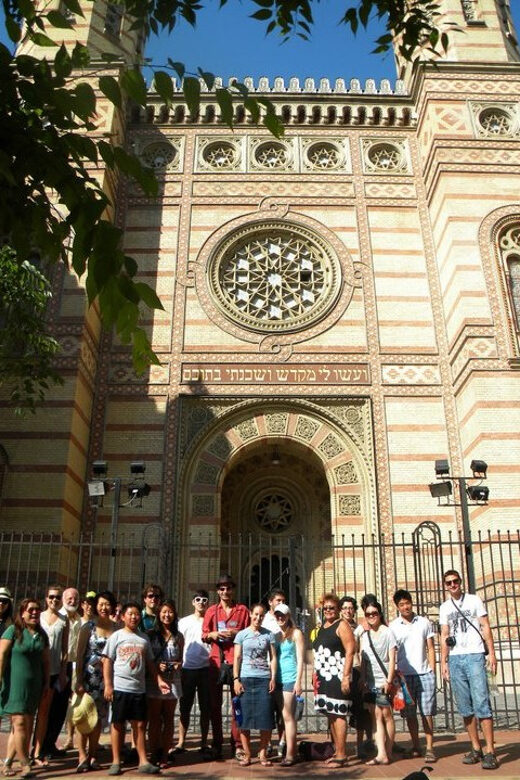
The tour centers on the legendary Jewish Quarter and the Jewish Triangle, which includes three synagogues. The key detail: you do not enter the synagogues on this tour.
That might sound like a letdown at first, but it can work in your favor. When a guide explains what you should look for—symbols, placement, and meaning—you start seeing the exterior details as part of the story. Then, if you want, you can follow up on your own and choose the time to go inside when it suits your schedule.
From the tour structure, you can think of this as a two-step plan:
- Step one: get the meaning of the area while standing in the right spot
- Step two: do self-guided synagogue visits afterward, on your own timing
This also means the walking tour stays focused. You’re not adding long waits inside, and you’re less likely to feel rushed through sacred spaces. Still, if your ideal day is heavy on interiors, you may want to pair this with separate synagogue entrance tickets.
Hungarian Jewish history and the Righteous Gentiles thread
The Jewish Quarter isn’t only architecture. It’s a place where history shows up in layers: community life, persecution, survival, and acts of help that mattered.
This tour specifically includes the history of Hungarian Jews and the idea of Righteous Gentiles—people who risked themselves to do what was right. That thread is important because it adds complexity. You’re not only learning about cruelty; you’re also learning about courage and moral choices.
The guides also bring in the kind of detail that makes the stories feel grounded. Reviews mention how guides handle difficult situations with respect, and how they answer questions rather than shutting them down. Some guides, like Judith, come through in the reviews as especially good at pacing and making each stop understandable, even when the subject matter gets heavy.
If you’re the type of traveler who wants more than a surface timeline, this is where the tour pays off. You’ll be asked to notice patterns in the neighborhood—symbols and references you can’t really connect without context. That’s also why hidden symbols and lesser-known narratives are repeatedly emphasized: the guide is teaching you how to read the district like a living document.
Guides like Judith, Andy, Ester, Gary, and Dora: what the best ones do
One thing that shows up strongly in the review scores is consistency in guide delivery. Many people mention guides who:
- answer questions freely
- pause at the right times so the group can catch up
- keep the tone respectful when topics get tough
- add humor without disrespecting the subject
Names come up again and again: Judith, Andy, Ester, Gary, Dora, Ursula, Edith, and Emmy appear in reviews. You can’t count on the same guide every time, but you can count on the style: active narration, room for questions, and clear explanations.
I also like that the reviews point to guides making it personal and attentive. For example, several comments mention a guide who holds attention and makes the walk feel like a conversation rather than a monologue. Others mention guides being patient and not trying to sell anything, which matters when you want a tour to feel like you’re learning, not being processed.
And if you want practical help beyond history: multiple reviews mention the guide offering suggestions for food and bars afterward. That’s not just nice; it’s useful. A good guide can steer you toward places that match your pace—somewhere you can actually relax after a serious hour and a half.






The ending stop at a local pub and why ruin bars fit this story
This tour doesn’t treat the Jewish Quarter as a museum-only district. It ends with a local pub stop, and reviews repeatedly mention ruin bars—especially finishing at a ruin bar area or pointing people toward spots like Bar Simplar.
Here’s why I think that ending works. After you’ve spent time on identity, survival, and community history, you’re ready for a softer landing. Ruin bars aren’t just nightlife. They’re part of Budapest’s modern way of reusing old spaces, giving new life to the neighborhood. That connection between past and present is exactly the kind of “today” context this tour says it wants to show.
Also, a pub stop can be practical. It helps you shift from tour mode into your own plan for the evening. Instead of wandering hungry and guessing where locals go, you get a starting point in the same area you just learned about.
If you’re specifically hunting for nightlife, this is a good way to get there with meaning attached. If you’re not a nightlife person, you can still use the pub stop as a convenient regroup point and head off when you’re ready.
Price and value: why the $2.27 booking fee is only half the story
The tour price shows at $2.27 per person, which can look confusing if you’re expecting a standard fee. Here’s how to understand it: that booking payment is described as an administrative and marketing fee that helps guarantee your spot. It does not go directly to the guide.
The guide’s income depends on your donation at the end. The tour info says you’re encouraged to tip what you feel the tour was worth, and it gives an example: most guests tip €10 per person, with some tipping more.
So how do you judge value? For me, the value calculation looks like this:
- You’re paying a low upfront amount for organization and your place on the walk.
- You’re then choosing the “fair wage” part at the end, based on how much you got out of the storytelling.
- You’re not paying extra for synagogue entrances because this tour does not include entry.
If you’re someone who loves history but hates tipping culture, this might feel less comfortable. But if you’re okay with pay-what-you-want guiding, it’s one of the fairest models: you only reward what lands for you.
Bottom line: if you enjoy a narrative-led walk, the cost structure is actually a strength. You control the final amount based on how well your guide connects the stories to the streets.
Who this Jewish Quarter walk is best for (and who should adjust expectations)
This tour is a great fit if you want a focused, story-driven Budapest Jewish Quarter walk that mixes history with present-day context. It’s also a good option if you like asking questions—reviews repeatedly mention guides being open to them and answering thoroughly.
It’s not the best choice if your top priority is synagogue interiors. Because you don’t enter synagogues here, you’ll need a separate plan if you want inside time.
English matters. The tour guidance says upper-intermediate English is essential to enjoy it and follow along. If you’re traveling with someone whose English is more limited, you might find the pacing and detail harder to track.
Group size is another practical factor: groups of 8 or more people are not allowed. If you’re booking as a large group, you’ll need to split differently or pick another format.
Finally, if you’re bringing very young kids: one review mentions it being manageable with toddlers only if they sit quietly in a stroller. So the tour is likely fine for families who can keep noise down, but it’s not designed for chaos.
Should you book this Jewish Quarter walking tour?
Book it if you want a short, high-impact walk where the guide helps you read the Jewish Quarter—through stories, symbolism, and historical context—and then send you into the neighborhood with a pub stop to cap the evening. The guide style comes through strongly in the ratings (4.7 from 369 reviews), with frequent praise for clarity, pacing, humor, and respectful handling of tough topics.
Skip it (or pair it) if you specifically want to enter and tour the synagogues on the spot. Also consider another option if upper-intermediate English is not realistic for you, or if tipping at the end would feel stressful.
If you do book, do two things to get the most out of it: show up ready to ask questions, and plan one follow-up stop on your own inside a synagogue afterward if that matters to you. That combination turns a good tour into a memorable, self-directed day.
FAQ
Where does the tour start?
Meet at the Budapest Eye ferris wheel meeting point, next to the fountain. Your guide will be holding a ROYAL BLUE flag.
How long is the walking tour?
The tour lasts about 1.5 hours. Starting times depend on availability.
Is the tour in English?
Yes. The live tour guide speaks English.
Do we enter the synagogues during the tour?
No. The tour does not include entering the synagogues. You can visit them on your own if you want.
What does the tour cover at the Jewish Quarter?
You’ll explore the Jewish Quarter and visit the three synagogues that make up the Jewish Triangle, with history of Hungarian Jews and the Righteous Gentiles, plus some context about modern Budapest.
How much does it cost?
The listing shows a price of $2.27 per person. The tour is also donation-based at the end, since guides rely on tips.
How much should I tip the guide?
The tour info says guides depend on donations. It encourages tipping what you feel it was worth, and notes that most guests tip €10 per person.
Is the tour wheelchair accessible?
Yes, it’s wheelchair accessible.
Can I cancel for a refund?
Yes. You can cancel up to 24 hours in advance for a full refund.