REVIEW · BUDAPEST
Communist Budapest Private Walking Tour
Book on Viator →Operated by Insight Cities · Bookable on Viator
Communism in Budapest has a street map. This private walking tour with a historian guide traces how communist power shaped public space from 1949 to 1989, using real buildings and statues as your timeline. I like the way the route mixes big landmarks with sharp, everyday details, so you’re not just reading names—you’re seeing how the system looked.
What I really enjoy is the local historian hosting style. Guides such as Andras and Kata bring the story down to street level, with clear explanations and strong context that helps you connect the dots between May Day parades, 1956, and the quieter routines people had to manage. It’s also built for flexibility, with a choice of morning or afternoon departure.
One thing to plan for: it’s a serious topic, and the pacing includes transit and heavy sights. Also, the House of Terror museum exhibit isn’t included—you only visit the exterior, though it’s the perfect spot to continue on your own.
In This Review
- Key things to know before you go
- How a communist power walk actually works in Budapest
- Getting around: start point, end point, and transit tickets
- Parliament to Liberty Square: 1956 in the foreground, Cold War in the background
- House of Terror outside: why ending here is such a smart move
- Socialist realist propaganda at Puskas Ferenc Stadium
- The Ronald Reagan statue: a surprising clue about Hungary’s role in the Cold War
- Bem József Square: 1956’s start and a 1960s coffeehouse interior
- Price and value: paying per group for a small-scale, guided story
- Who should book this tour (and who might not love it)
- Should you book this Communist Budapest Private Walking Tour?
- FAQ
- How long is the Communist Budapest private walking tour?
- Is this tour private?
- Do I need tram and metro tickets?
- Where do I meet the guide, and where does the tour end?
- Is entry to the House of Terror Museum included?
- Is free cancellation available?
Key things to know before you go
- Private historian guide: Expect a guided walk that explains the how and why, not just dates.
- Cold War focus from 1949–1989: You’ll see what communist rule did to squares, institutions, and public art.
- Route uses transit: You’ll move by subway, tram, and walking, with help if you don’t have a pass.
- Bem József Square stop: The 1956 uprising connection and a coffeehouse with a 1960s interior are standout moments.
- Propaganda seen in stone: Socialist realist statues and regime symbolism show up in multiple locations.
- House of Terror exterior only: The tour ends there, but if you want the exhibits, you’ll need extra time and tickets.
How a communist power walk actually works in Budapest
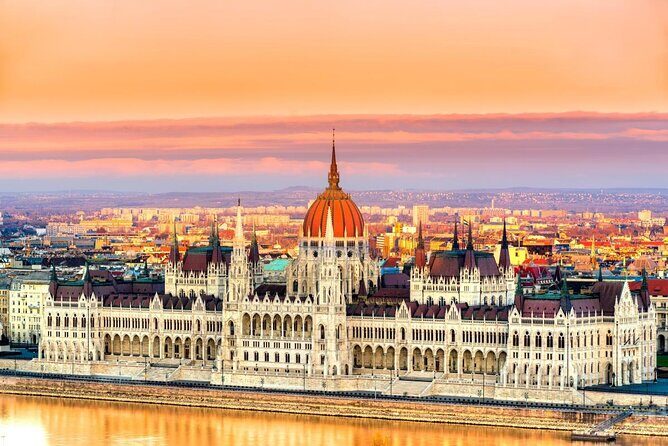
This is the kind of tour that helps you see Budapest like a document. Instead of treating communism as a set of distant events, you follow it through the city’s layout—squares built for gatherings, monuments meant to persuade, and institutions that signaled who was in charge.
You’ll start with a classic “power view” in the Parliament area and then keep moving across Cold War flashpoints. The story isn’t told from one museum room; it’s told from outside buildings, where the meaning comes through quickly. That makes the tour ideal when you want context without adding more ticket lines and time inside.
Duration is about 3 hours. In one case with Andras, the tour ran a bit longer (around four hours) after the guide adjusted to what the group wanted. So think of it as a guided half-day you can actually use to plan the rest of your Budapest day.
Group size is small. The pricing is per group (up to 10 in the listing pricing), and the operator notes a smaller maximum group size (up to 8). Either way, the private setup is what you’re paying for: you can ask questions and get answers tuned to your interests.
You can also read our reviews of more walking tours in Budapest

Getting around: start point, end point, and transit tickets
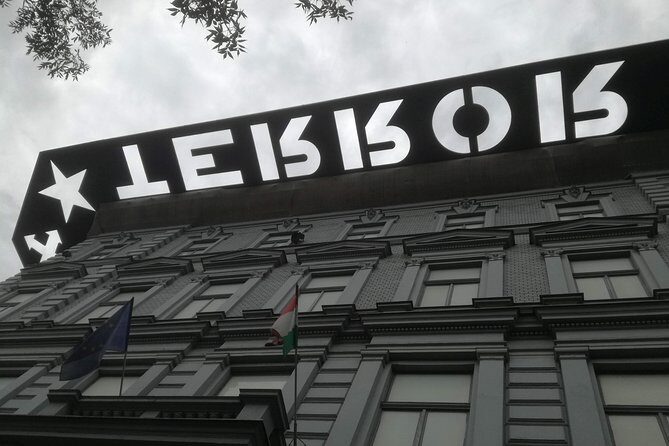
This tour is set up like a real city walk. You meet at Frankel Leó út 2-4, 1027, and the tour ends outside the House of Terror at Andrássy út 60, 1062. That matters because your last stop is not a random parking-lot finale—it’s where Budapest’s communist-era story gets very tangible.
Pickup is offered. If you want it, the guide meets you at your central hotel or flat, then leads you by metro, tram, or foot depending on how close the next sites are. If you don’t want pickup (or don’t provide your address), you’ll meet your guide 15 minutes before the start time at the default meeting point.
Tram and metro tickets are not included, but the guide will help you buy what you need if you don’t have a pass. This is a practical advantage: you avoid the “what ticket do I buy?” stress and you keep moving.
Because the tour covers multiple areas, wear comfortable shoes. You’re not climbing mountains, but you are walking enough that your feet will notice.
Parliament to Liberty Square: 1956 in the foreground, Cold War in the background
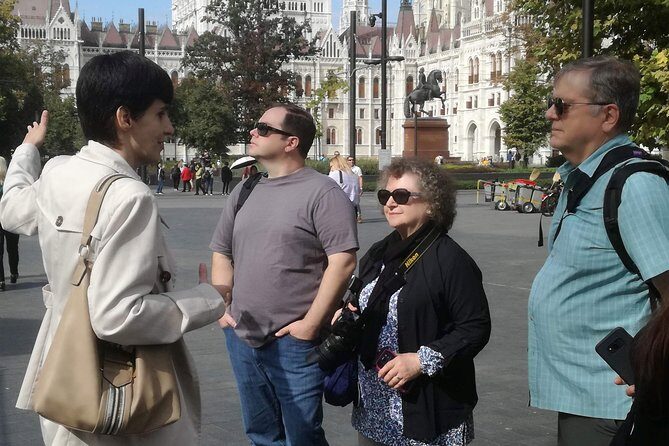
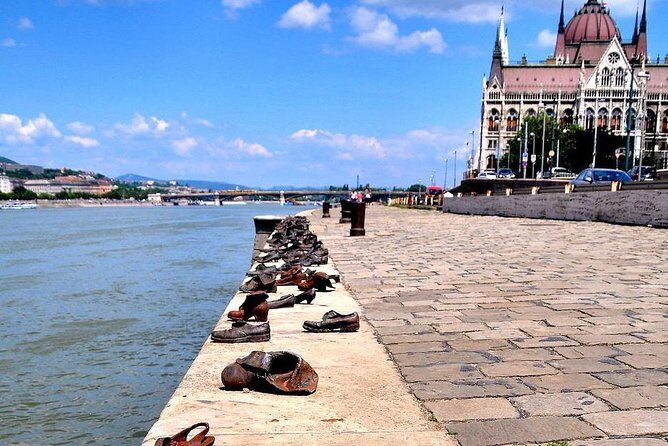
The first leg gives you the big visual context right away. You head to Kossuth Square in front of the Hungarian Parliament Building, and your guide points out monuments connected to the 1956 Hungarian Revolution. This sets a tone: communism here isn’t just a regime; it’s a story of pressure, protest, and political confrontation.
From there, you continue toward Liberty Square and the surrounding Cold War landmarks. You’ll cover the US Embassy area, a monument to the Soviet Army, and a set of symbols that show how the city handled shifting power relationships. The tour also mentions an atomic shelter, which is one of those details that makes the Cold War feel oddly physical—like the fear was planned into the streets.
Why this stop is valuable: it trains your eye. Once you’ve seen how monuments and institutions are placed to shape public perception, the rest of the walk reads more clearly. You stop thinking of the skyline as decoration and start thinking of it as messaging.
A small drawback: this is where the tour can feel most “political headline.” If you prefer lighter, less intense sightseeing, you might want to mentally prep for the tone.
House of Terror outside: why ending here is such a smart move
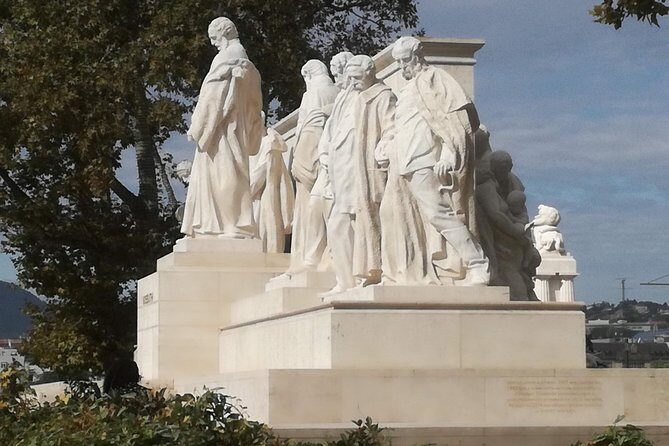
The tour’s endpoint is outside the House of Terror Museum, housed in the former headquarters of Hungary’s communist secret services. In front, you’ll see a slab of the Berlin Wall. Even from the sidewalk, that concrete chunk communicates volume: borders, surveillance, and the culture of control that defined much of Eastern Europe during the Cold War.
Here’s the key practical note: the museum exhibit itself is not included. The tour uses the exterior as a historical and symbolic wrap-up. That can be a good thing if you want a clear finish without committing to a long museum visit on top of the walk.
Still, it’s a natural add-on. If you’re interested in Hungary’s Cold War experience and you want to follow the story further, this is the best possible place to spend extra time. Ending outside also makes it easier to plan your evening—either you head home or you choose to go in while the walk’s context is still fresh.
Socialist realist propaganda at Puskas Ferenc Stadium
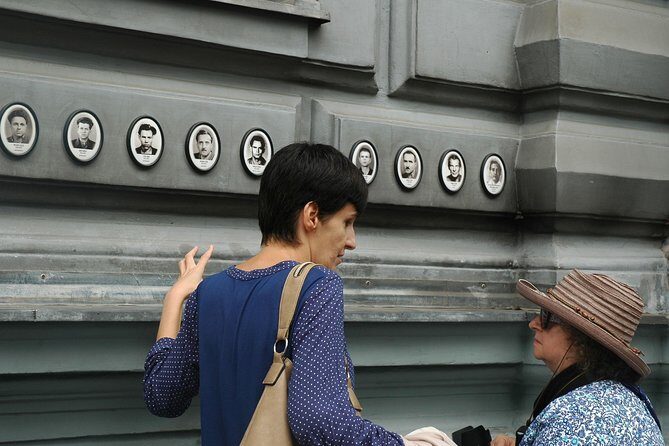
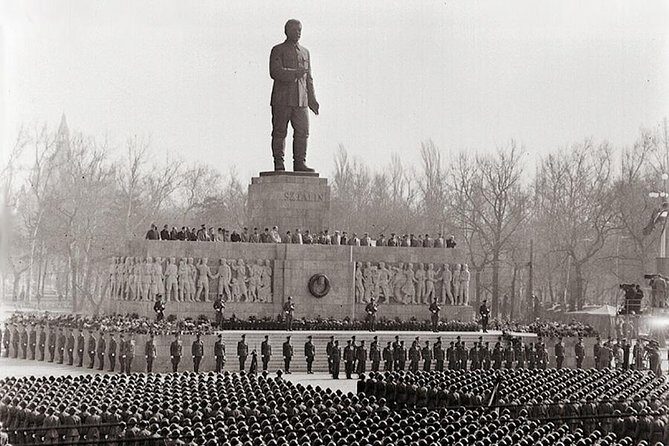
Next you move to the former People’s Stadium, now Puskás Soccer Stadium. The important part here isn’t sports—it’s the leftover styling. The stop highlights classic socialist realist statues still standing, a reminder that propaganda wasn’t always hidden away. It was built into public landmarks that people used every day.
This is one of those stops where your guide’s storytelling matters. Without context, you might see statues and assume it’s just old decoration. With context, you start reading the messages: which heroes are elevated, which ideals get carved in stone, and how public art was used to suggest what citizens should value.
There’s also a practical bonus: you get a break from constant narration around museums and government buildings. It’s visual, open-air, and it feels less like you’re trapped in a history lecture.
You can also read our reviews of more private tours in Budapest




The Ronald Reagan statue: a surprising clue about Hungary’s role in the Cold War
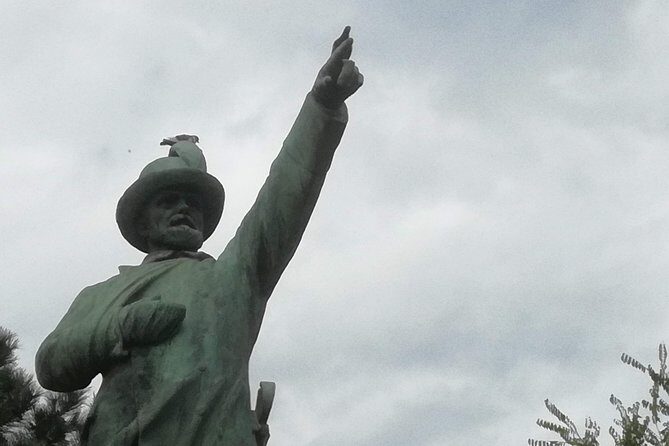
One of the tour’s most interesting symbolic moments comes around the Ronald Reagan statue. The story here is about recognition—Hungary’s sense of obligation to this US president for efforts tied to bringing down the Iron Curtain.
That idea is worth pausing on. The Cold War didn’t end with a single handshake; it ended through shifting pressure, negotiation, and sustained political change. Seeing Reagan honored in Budapest helps you understand that communist history is not only about the East—it’s also about the external factors that affected life inside the bloc.
It also connects nicely to earlier parts of the walk. Once you’ve looked at Soviet monuments and Cold War siting, Reagan’s presence feels less random and more like another page in the same lesson: public space becomes a scoreboard of political influence.
Bem József Square: 1956’s start and a 1960s coffeehouse interior
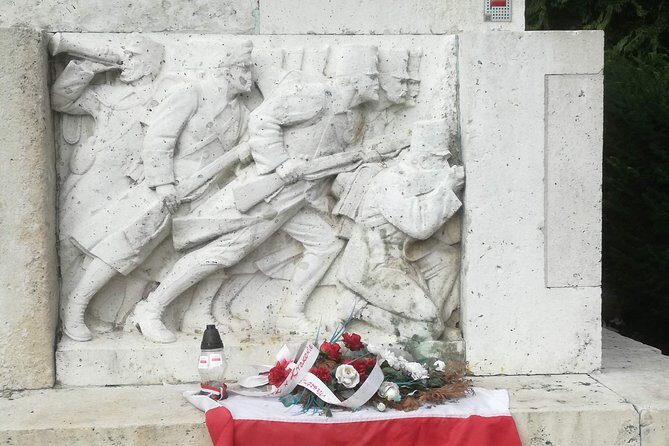
The walk ends in the kind of place where history and daily life overlap. At Bem József Square, you’re tied back to the 1956 uprising. This stop is especially good because it anchors the revolution in a real gathering space rather than treating it like an abstract event.
The square also includes a coffeehouse that has retained its original interior from the 1960s. That matters more than it sounds. When you can see how a place looked during the era you’re learning about, it helps you imagine the routines people lived with—family conversations, quick breaks, and the ordinary rhythm that continued even when politics tightened.
Why this stop is a standout: it gives you contrast. Earlier stops are heavy and monumental. Here, you get a chance to absorb the era’s texture. Even if you don’t go inside, the presence of that interior detail makes the period feel closer.
Price and value: paying per group for a small-scale, guided story
The price is $393.17 per group (private, up to 10 in group pricing) for about 3 hours. On the face of it, that isn’t “cheap.” But it can be good value depending on how many people are in your group and how much you want real context.
Here’s the value logic:
- You’re hiring a private historian guide, not a basic general tour.
- You’re getting a route that links multiple political layers—revolution sites, Cold War institutions, propaganda locations, and symbolic monuments—without you having to research each stop yourself.
- Transit help is included in practice: the guide assists with metro/tram tickets if needed, and pickup can reduce friction if you’re staying in central areas.
If you have 4 to 8 people, the per-person cost usually becomes more reasonable compared to joining a larger group. If you’re traveling as two, it’s still doable, but you’ll want to decide whether you value private guiding enough to justify the premium.
Who should book this tour (and who might not love it)
Book this if you:
- Want Budapest history tied to what you can actually see on the street.
- Like guided explanations that connect 1956, the Soviet relationship, and the Cold War into one narrative.
- Want a private format so you can ask questions and move at a pace that fits your curiosity.
Skip it or pair it carefully if you:
- Prefer “light and scenic” walking tours over political themes.
- Want museum entry included as part of the package, because the House of Terror exhibit is not part of this tour.
It also makes a great add-on day component. For example, you can do a more general Budapest sights morning and then use this tour to add the political and cultural spine in the afternoon.
Should you book this Communist Budapest Private Walking Tour?
I’d book it if you want your Budapest to make sense beyond postcard views. The route is designed to show how communist power worked through space—squares built for gatherings, monuments built to persuade, and institutions built to control. Ending outside the House of Terror is also smart planning because it sets up a natural next step if you want to go inside.
If you’re sensitive to darker subject matter, or you’re hoping for purely sightseeing, you may find the tone more intense than you expected. And remember: the tour gives you the exterior context at House of Terror, not the exhibit time.
Overall, this is a strong fit for travelers who want a private guided story and don’t mind that Budapest’s 20th-century history can be heavy.
FAQ
How long is the Communist Budapest private walking tour?
It runs for about 3 hours.
Is this tour private?
Yes, it’s a private guided walking tour with a historian guide.
Do I need tram and metro tickets?
Tram and metro tickets are not included. The guide will assist you with purchasing the required tickets if you don’t already have a transport pass.
Where do I meet the guide, and where does the tour end?
You start at Frankel Leó út 2-4, 1027 Hungary. The tour ends outside the House of Terror Museum at Andrássy út 60, 1062 Hungary.
Is entry to the House of Terror Museum included?
No. The tour ends outside the museum; the exhibit inside is not included.
Is free cancellation available?
Yes. You can cancel for a full refund up to 24 hours before the experience’s start time.