REVIEW · BUDAPEST
Buda Castle Private Walking Tour: A Kingdom of Many Nations
Book on Viator →Operated by Insight Cities · Bookable on Viator
One hill, six centuries of power. Castle Hill turns into a living timeline when you walk it with a guide who explains how each empire left fingerprints. I love the historians’ level commentary that turns big monuments into clear stories, and I love the flexibility of a morning or afternoon start so you can match your Budapest day. One thing to consider: not every major stop includes tickets, so you’ll want to be ready to pay for entry to Matthias Church and Fisherman’s Bastion if you want to go inside.
This is a private walking tour (up to a small group), centered on Buda Castle and the surrounding views that define the riverfront skyline. You’ll also get a quick look at places that connect the old royal era to modern Hungary, like Sándor Palace, home to the President. If you get a guide like Kata or Julia (names highlighted in prior experiences), expect close attention to details and context that makes the stones feel relevant instead of just scenic.
In This Review
- Key points before you go
- A Kingdom of Many Nations on Castle Hill
- The 3-hour walking loop: how the route actually feels
- Buda Castle: the palace that kept changing jobs
- The building’s changing function: the part that sticks
- Matthias Church: ticket stop with a big visual payoff
- Fisherman’s Bastion: where seven towers turn into a myth
- Sándor Palace and Vienna Gate: old power meets modern Hungary
- Price and group size: does private work here?
- The one drawback to plan for: tickets and expectations
- Who this tour fits best
- Should you book the Buda Castle Private Walking Tour?
- FAQ
- How long is the Buda Castle private walking tour?
- Is pickup available for this tour?
- What language is the tour offered in?
- Which stops require tickets?
- Where do I meet the guide?
- How many people are in a group?
- Can I get a full refund if I cancel?
Key points before you go
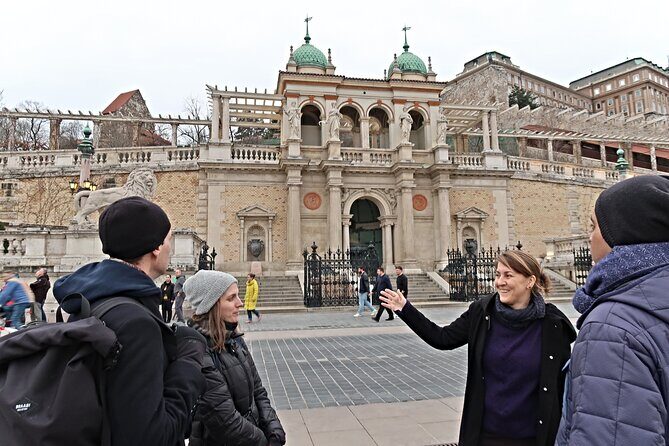
- A historian guide pace that explains what you’re looking at, not just where to stand for photos
- Castle Hill on foot for a tight 3-hour route with smart viewing stops
- Matthias Church and Fisherman’s Bastion tickets aren’t included, so plan for entry costs
- You start with the big-picture palace view, then zoom in on specific sites
- Small private group for easier questions and less time stuck behind other people
A Kingdom of Many Nations on Castle Hill
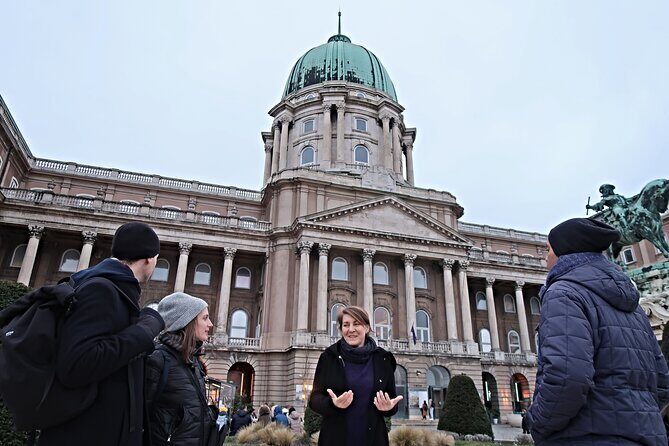
Budapest’s Castle Hill can look like postcard scenery from afar, but up close it’s more like a set of overlapping drafts. You can see how the city rebuilt itself after conquest, fire, and political change. This tour leans into that idea, treating the hill as a timeline of shifting rulers and changing roles for the same spaces.
The main payoff for me is how the guide connects architecture to political power. When you learn that the palace was rebuilt and re-rebuilt—then only took its current “eclectic” look after World War II—it stops being abstract. You start noticing details that used to be invisible. And because you’re walking, you get to experience the hill’s narrow, cobbled feel rather than just looking at a façade from one spot.
You can also read our reviews of more walking tours in Budapest



The 3-hour walking loop: how the route actually feels

The tour runs about 3 hours, with a choice of morning or afternoon departure. That flexibility matters here, because Castle Hill is best when you can take your time at the viewpoints without rushing. I’d pick the time that fits your energy level and your sightseeing rhythm—then accept that this is a walking, story-driven route, not a museum marathon.
Your itinerary is structured like this: you begin with the palace area and overview impressions, then you move site by site—Matthias Church, Fisherman’s Bastion, and the ending viewpoint at Vienna Gate. Along the way, your guide keeps returning to cause and effect: who ruled, what they built, what changed, and what survived.
Since this is private, you also gain a small advantage that’s easy to miss: you can ask why something looks the way it does. In crowded group tours, you often don’t get that moment. Here, the guide’s job is to translate what you see into meaning.
Buda Castle: the palace that kept changing jobs
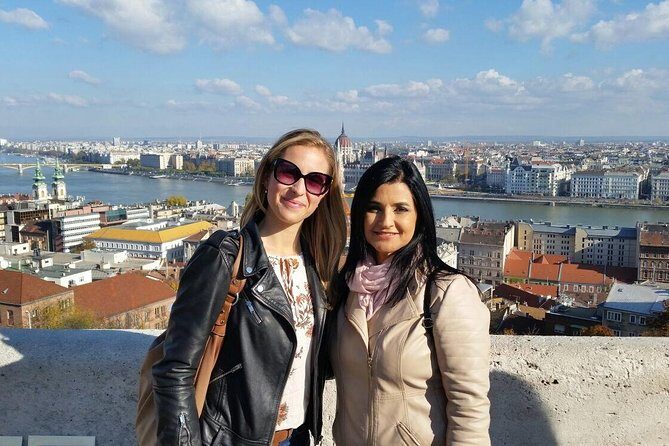
You start where Castle Hill’s story becomes unavoidable: the palace zone and the iconic silhouettes that define the area. From the hill, two landmarks dominate—the massive palace at the southern tip and Matthias Church’s colored roof with its pointed steeple. Even if you never pay for palace interior entry on this route, you’ll leave with a strong sense of how the hill’s layout supports royal power.
At the start, you get about 2 hours of time focused on the Castle Hill experience. This is the best segment for getting oriented. You’ll walk through the old-city atmosphere—tight streets, cobbles underfoot, and architecture that looks built for defense and ceremony at the same time.
Then you shift into a faster historical thread tied directly to the palace itself. The palace wasn’t a single fixed thing; it was a political project that rulers kept rewriting. Your guide explains that the earliest major fortress on the hill came after the Mongol invasion, when King Béla IV erected defenses around 1250. Later, Renaissance power arrived with King Matthias, turning the area into a famous court in Europe at the end of the 15th century.
And then comes the Ottoman-era layer. The region was ruled by Turkish pashas for over 150 years, and afterward came the Hapsburg emperors. The result is a building that feels like it has many personalities, even if you’re only looking at a few façades. That’s why this stop is one of the tour’s strongest values: you get a clear sequence for what your eyes are picking up.
The building’s changing function: the part that sticks
One of the most useful moments in this tour is the explicit discussion of the palace’s changing function over time. It’s easy to see “old building” and move on. It’s harder—and more interesting—to understand what power needed from this site at different points in history. Was it a fortress? A court? A symbol? A thing to defend? A stage for a new ruling class?
Once you hear those role changes, you’ll start spotting how each era left marks that still affect how the hill feels today. That’s the kind of mental map that makes a first visit turn into something memorable.
Matthias Church: ticket stop with a big visual payoff
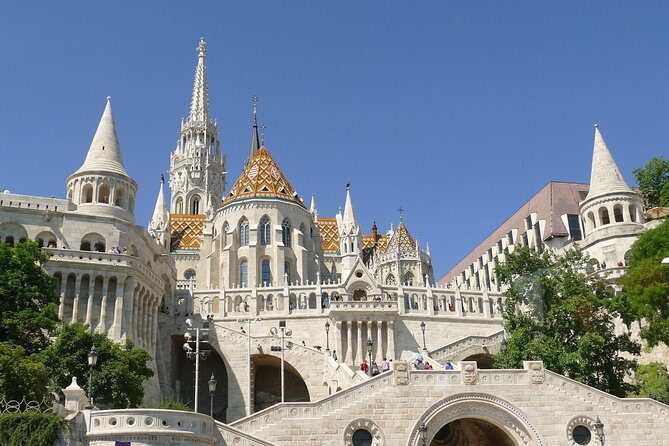
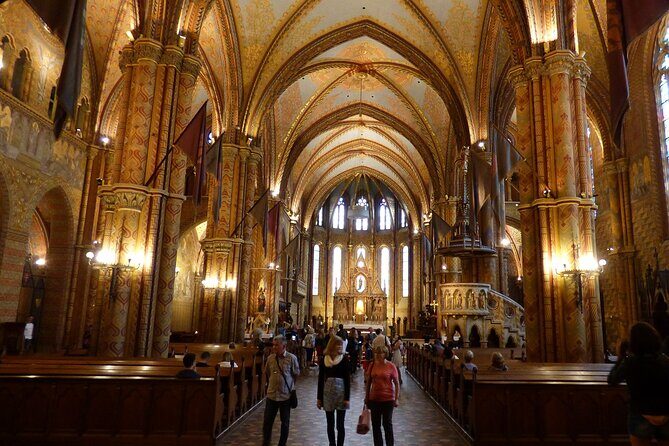
Matthias Church is one of those places you notice from far away—and then again when you’re right next to it. The tour gives you about 20 minutes here, and tickets are not included. So what you’re paying for with the guide is more than entry; it’s context. You’ll understand why this church looks the way it does and why its details matter.
This is a Neogothic reconstruction from the end of the 19th century, and it’s described as a kind of architectural fantasy: finely executed, highly decorated, and designed to be striking. The roof is the headline outside, with abundant decoration that practically begs for you to keep looking up.
Inside, the tour framework keeps things practical. You’re not turning this into a long, slow church lecture. Instead, you get enough time to appreciate the interior as part of the larger Castle Hill story—especially compared to the palace’s shifting functions and the later myth-making of national identity tied to the area.
If you want the full experience, treat this as your main ticket purchase. If you don’t go inside, you’ll still get the exterior impact, but the architecture story is strongest when you can see the interior too.
You can also read our reviews of more private tours in Budapest






Fisherman’s Bastion: where seven towers turn into a myth

After Matthias Church, you move to Fisherman’s Bastion for another 20 minutes, with tickets also not included. This stop is less about deep political detail and more about national symbolism and the payoff viewpoint—so it pairs well with the prior historical focus.
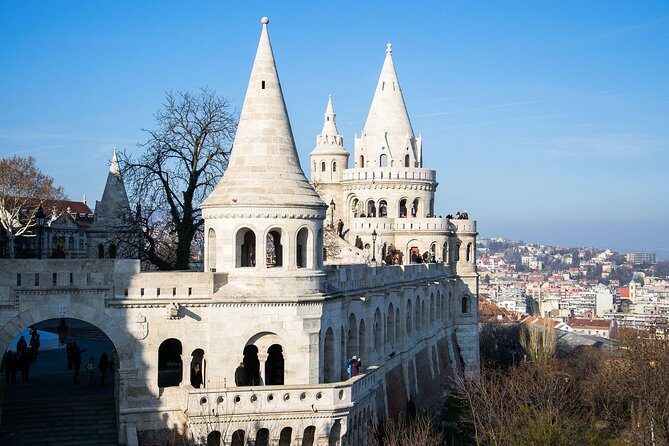
Fisherman’s Bastion is built in neo-Gothic and neo-Romanesque styles, and it was designed and constructed between 1895 and 1902. That timeframe matters because it tells you this isn’t just medieval re-enactment. It’s late-19th-century storytelling through architecture: a way to shape how visitors and locals imagine the past.
The seven towers represent the seven Magyar tribes that settled in the Carpathian Basin at the end of the 9th century. Once you know that, the structure stops being “pretty” and becomes a symbolic diagram. You’ll also appreciate the terrace views, one of the reasons this place is famous: you can see the Danube, Margaret Island, Pest, and even Gellért Hill from here.
My practical take: this is one of the best spots on the whole route for a calm photo moment—because it’s designed for looking outward. Plan your photo burst, but also give yourself time to just look without the phone for a few minutes. The point here isn’t only to capture the view. It’s to connect how the hill dominates the riverfront and why this location became so valuable.
Sándor Palace and Vienna Gate: old power meets modern Hungary

This tour doesn’t only dwell in medieval dreams. It includes a quick stop at Sándor Palace, which is the official residence of the President of Hungary and the seat of the Office of the President since 2003. The original palace was built in neoclassical style in 1806, commissioned by Count Vincent Sándor, an aristocrat and philosopher in the Austro-Hungarian Empire.
That pairing—medieval fortress energy on one side, modern state power on the other—is exactly what makes Castle Hill feel like a living city. You’re not just walking past buildings frozen in time. You’re watching a place evolve to meet new political realities.
Then you finish at Vienna Gate, where your tour ends with a view stretching toward Óbuda (Old Buda). Here, the Roman settlement Aquincum enters the story, giving you a longer time horizon than the medieval focus you’ve been tracking. The end viewpoint ties everything together: you started with a hill shaped for defense and ceremony, and you end with the sense that this region was important long before any single empire arrived.
Price and group size: does private work here?
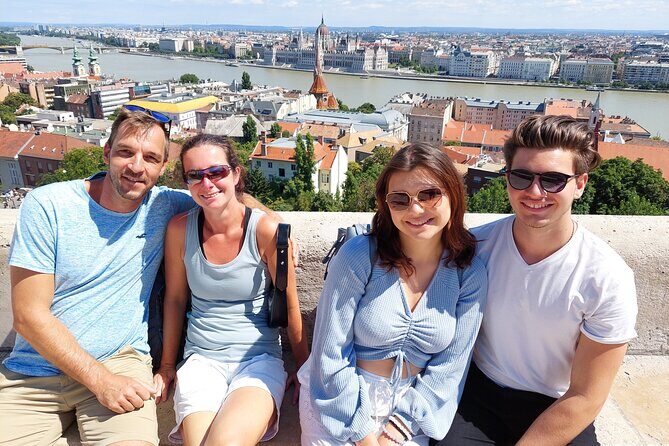
The price is listed as $397.36 per group for up to 10 people, and the tour duration is about 3 hours. That number sounds high at first glance, but you should think in terms of what you get: private guiding plus a tight, story-focused route that covers multiple signature sites in one go.
If you’re traveling as a couple or a small group, the cost often makes sense because you’re buying time and clarity. You’re not spending that time hunting for meaning on your own, and you’re not losing attention to logistics while you figure out where to go next.
Also, the tour is capped at a small number—your data shows a maximum of 8 per booking even while the group price listing mentions up to 10. Either way, the experience is positioned as small-group or private, which is where you feel the value most.
One practical tip: compare this cost to how much you’d pay for separate entry tickets plus guide time. Matthias Church and Fisherman’s Bastion tickets aren’t included, so budget for those separately. Still, the guide’s interpretation is included, and that’s the difference between seeing buildings and understanding them.
The one drawback to plan for: tickets and expectations
The biggest expectation wrinkle is ticket inclusion. Buda Castle areas you view on this route are marked as ticket free, and the stops at Sándor Palace and Vienna Gate are also listed with free admission. But Matthias Church and Fisherman’s Bastion are specifically marked as tickets not included.
So if your dream is to walk in everywhere without paying extra, this might not match that. If your goal is to understand the hill and enjoy the views, this plan works well—just budget for the two ticket stops.
There’s also an important lesson from a low-rating experience you might stumble across: sometimes people assume the tour includes all castle interior access. Your itinerary is built around the walk and the key visual and interpretive stops, not a full museum circuit. If you want guaranteed interior time at a specific place, make sure your plan includes the ticketed segments.
Who this tour fits best
This is a great choice if you want context more than you want a checklist. It suits first-time Budapest visitors who feel overwhelmed by multiple emperors, architectural styles, and time periods. It’s also ideal if you’re the type who enjoys asking why a building is where it is and why it looks the way it does.
If you travel with someone who gets bored on general sightseeing tours, the historian-style explanation can keep everyone engaged. You don’t just see Castle Hill—you learn how the same location served different rulers and functions.
And because there’s a choice of morning or afternoon, you can fit it into a day plan that includes other parts of Budapest without forcing a single rigid schedule.
Should you book the Buda Castle Private Walking Tour?
Book it if you want Castle Hill to make sense fast. The combination of private guiding, a tight 3-hour route, and specific stops that cover both symbolism (Fisherman’s Bastion) and political evolution (the palace zone and Sándor Palace) is a solid value for the money—especially when you learn the story behind what you see.
Consider booking a different option if you know you only care about ticketed interiors and want a tour that includes everything. Since Matthias Church and Fisherman’s Bastion tickets are not included, you’ll have a couple extra costs and you’ll need to decide in advance how much interior time you want.
If you want your Budapest day to feel like a guided walk through a kingdom of shifting identities, this tour does that job very well.
FAQ
How long is the Buda Castle private walking tour?
The tour lasts about 3 hours.
Is pickup available for this tour?
Pickup is offered. If hotel pickup has not been arranged, you’ll meet your guide 15 minutes before the start time at the default meeting point.
What language is the tour offered in?
The tour is offered in English.
Which stops require tickets?
Matthias Church and Fisherman’s Bastion tickets are not included. Other listed stops are marked as free admission on this route.
Where do I meet the guide?
Unless pickup is arranged, you meet 15 minutes before the start time at Bálthazár (a hotel with a café) on Országház utca 31, 1014 Budapest.
How many people are in a group?
The experience data lists a maximum of 8 people per booking, with a maximum of 10 travelers for the activity.
Can I get a full refund if I cancel?
Yes. You can cancel up to 24 hours in advance for a full refund.